
On 12 February 2026, President Cyril Ramaphosa presented South Africa’s State of the Nation Address (SONA). The SONA is an annual occasion during which the President outlines the country’s progress, challenges and priorities before a joint sitting of Parliament, comprising the National Assembly and the National Council of Provinces. The address officially signals the start of the parliamentary year.
As Green ELCSA, we believe that SONA is not just a political speech. It is a moral moment in the life of the nation. And the Church cannot be absent from moral moments. We set and listened to the SONA not only as South African citizens, but as people of faith committed to climate justice, ecological stewardship and the dignity of all creation.
The President acknowledged that South Africa is “increasingly vulnerable to extreme weather conditions,” referencing recent catastrophic flooding in Limpopo and Mpumalanga that claimed lives and destroyed infrastructure. This recognition matters. Climate change continues to devastate our communities. In this speech, climate change was presented as a disaster response challenge, an infrastructure issue, and an economic opportunity.
As a faith-based movement, Green ELCSA affirms that climate change is also a moral and spiritual crisis, and a crisis of inequality. Because it disproportionately harms those who have contributed the least to its causes. It deepens poverty, destroys homes and livelihoods, threatens food and water security, and exposes vulnerable communities, especially women, children and the poor, to heightened risk. Climate change is moral because it raises urgent questions about justice, responsibility and accountability. It is spiritual because it reflects a broken relationship between humanity and creation, where greed, overconsumption and exploitation have replaced stewardship and care. And it is a crisis of inequality because its impacts mirror and magnify the historic injustices that continue to shape our society.
The President celebrated the end of load shedding and announced that by 2030 more than 40% of South Africa’s energy will come from renewable sources. He also highlighted approximately R250 billion pledged to the Just Energy Transition Investment Plan. These two plans are closely linked to South Africa’s Nationally Determined Contributions (NDCs) under the Paris Agreement and the Just Energy Transition Partnerships (JETPs).
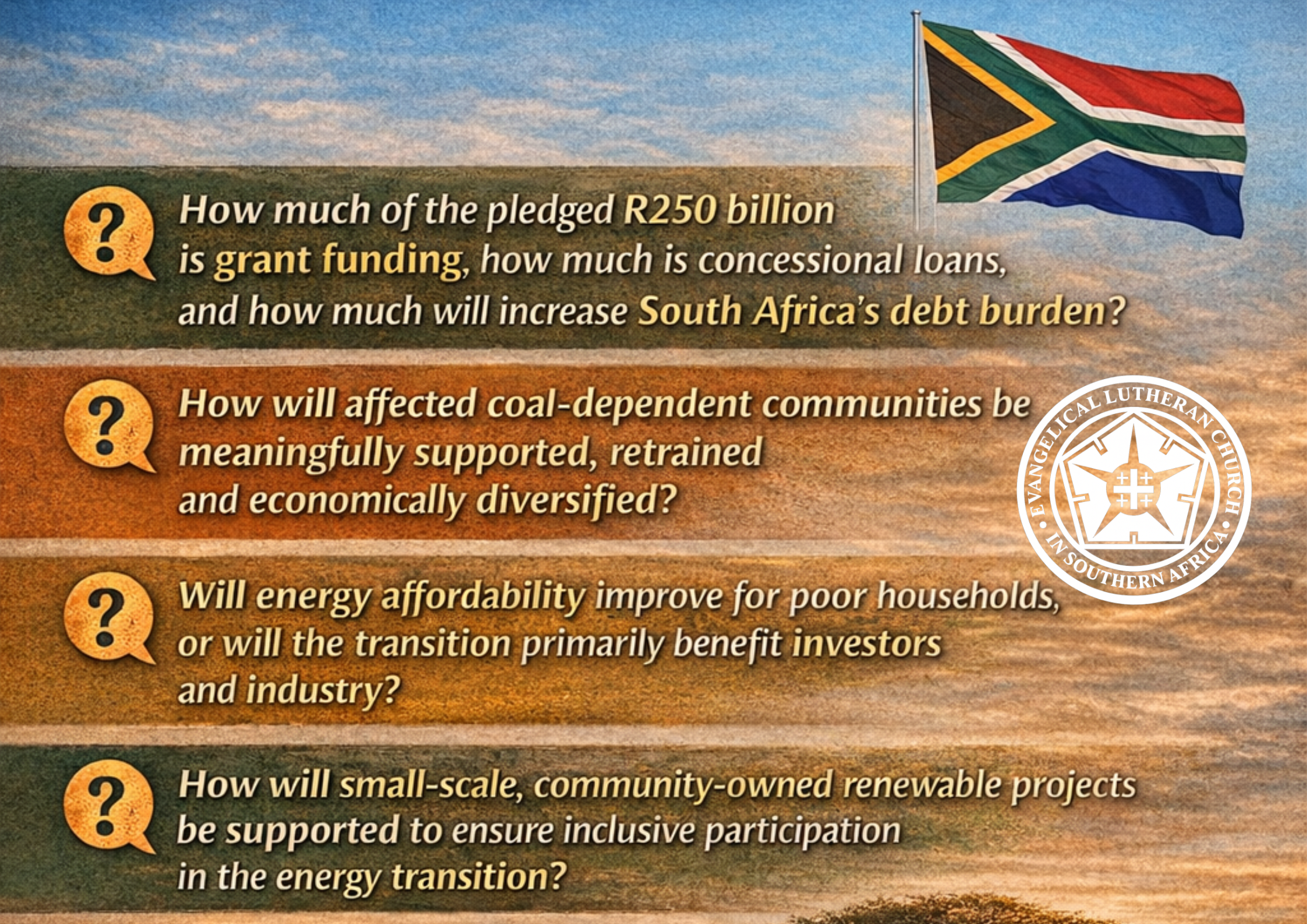
There are, however, a number of important questions that remain unanswered. Some of them include:
How much of the pledged R250 billion is grant funding, how much is concessional loans, and how much will increase South Africa’s debt burden?
How will affected coal-dependent communities be meaningfully supported, retrained and economically diversified?
Will energy affordability improve for poor households, or will the transition primarily benefit investors and industry?
How will small-scale, community-owned renewable projects be supported to ensure inclusive participation in the energy transition?
Without clear answers to these questions, the promise of a “just” transition risks becoming a technical reform rather than a deeply transformative social and ecological shift.
The President described water as “the single most important issue” for many South Africans today, and committed R156 billion to water and sanitation infrastructure over three years. This is welcomed and necessary. From a theological perspective, water is more than infrastructure: it is life, dignity and sacred. When taps run dry in Giyani or Johannesburg, this is not just administrative failure, it is a justice failure.
The President declared that “the biggest opportunity of all lies in green growth.” He announced:
A 150% tax deduction for new energy vehicles,
Expansion of battery manufacturing,
Investment in critical minerals,
Industrial green products for export.
Green industrialisation holds potential for jobs and innovation. But we must ask: Will rural communities genuinely benefit? The Industrial Development Corporation recently announced more than R300 million in funding for the Frontier Rare Earths Project in the Northern Cape, one of the most rural provinces in the country. The project has the potential to position South Africa as a key supplier of critical minerals for the global green economy. But will local communities see long-term employment, or primarily short-term construction jobs? And how will land rights, water use and environmental impacts be managed in a province already facing water scarcity?
If green industrialisation replicates extractive patterns of the past, where rural land bears the burden and urban centres capture the value, then the transition cannot be called just. A truly just green economy must ensure that rural provinces like the Northern Cape are not merely sites of extraction, but centres of empowerment, ownership and sustainable development.
Towards the end of the speech, the President spoke of a nation “turning towards hope.” Hope, in Christian faith, is not passive optimism. It is an active commitment. It is not wishful thinking that things will improve on their own, but a deliberate decision to participate in God’s work of restoration and justice. If South Africa is indeed turning towards hope, then that hope must be visible in how we protect the poor, how we care for the earth, how we transition our energy system, and how we govern with integrity. A hopeful nation is one that chooses justice, accountability and compassion, not only in rhetoric, but in policy and daily life.